Why Social Proof Is Failing on Your Store (And How to Fix It)
Home Blog D2C
By: Kirtika Srivastava Published: Aug 02, 2026
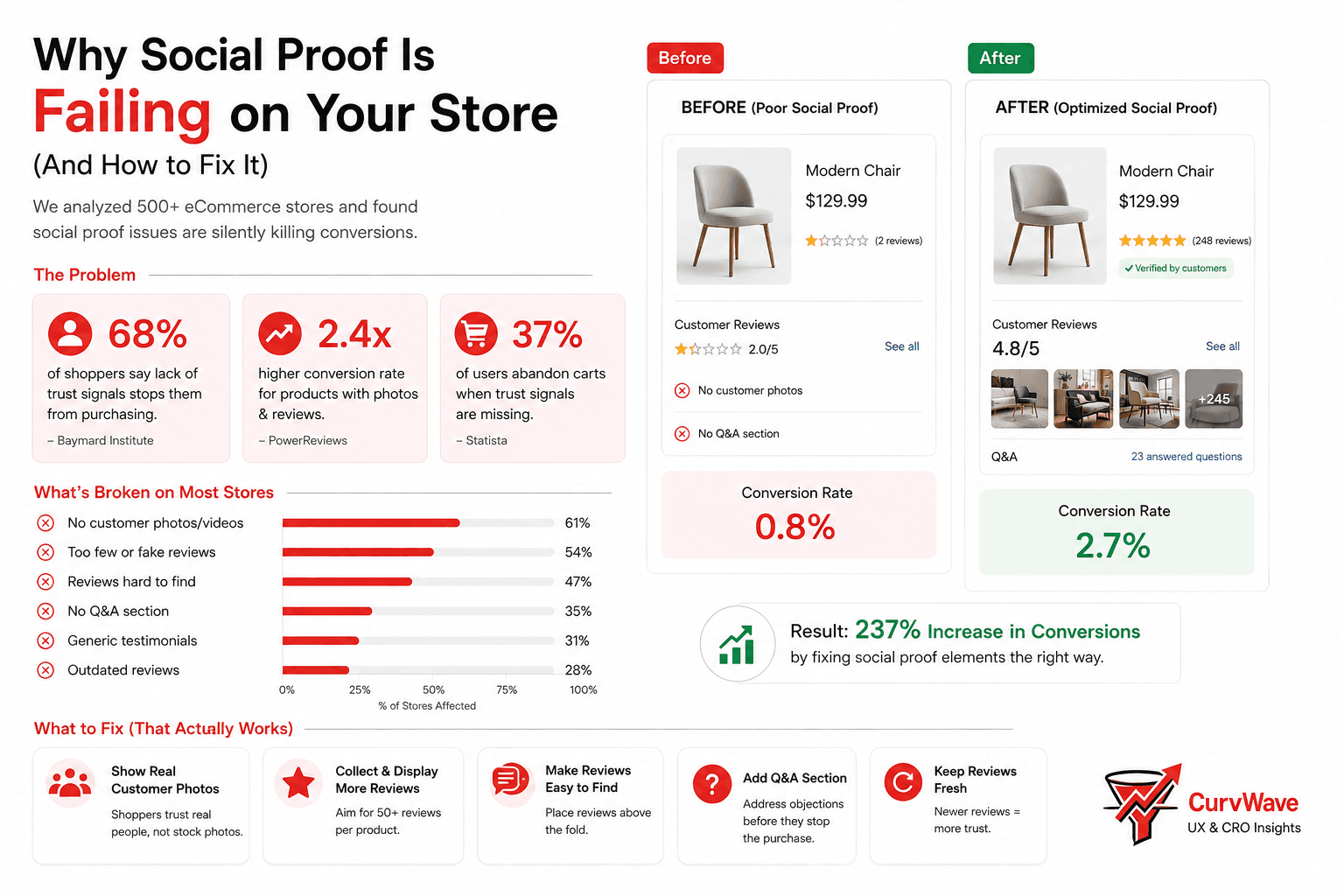
When consumers land on a new D2C store, their built-in skepticism radar is fully active. During our website reviews, we frequently notice brands relying on lazy, unverified testimonial blocks that look entirely manufactured. When social proof lacks specific human details, it actually triggers doubt rather than confidence.
Modern shoppers look past generic praise and search for authentic validation that addresses their specific objections and fears before committing their money.
1. The Flaw of Vague, Generic Praise
Testimonials that simply say "Great product, fast shipping!" add zero conversion value. They could apply to literally any business on the internet, failing to convince a hesitant buyer.
The Fix: Highlight context-rich reviews that mention specific pain points, solve a concrete problem, or detail how the product performed over time. Let your real customers do the heavy lifting by describing the exact transformation they experienced.
2. Hiding Social Proof Below the Abyss
If a user has to scroll past your entire product catalog just to find out if other people actually like your brand, you are missing out on high-intent conversion momentum.
The Fix: Integrate micro-social proof directly into the primary viewport. Place verified buyer counts, star ratings near the title, or short photo reviews right beside the main purchase area.
3. Ignoring Visual and Contextual UGC
Text-only reviews force readers to imagine the product in real life. Without visual proof, skepticism remains high, especially for lifestyle, apparel, and physical goods.
The Fix: Embed user-generated photos and short videos directly into your product gallery and review sections so shoppers can see real humans using and loving your items.
Conclusion
True authority isn't about claiming you are the best—it is about letting your community prove it for you. Align your social proof with human psychology, and watch customer trust compound into higher revenue.
Want to turn passive visitors into loyal brand advocates? Let CurvWave run a comprehensive UX & CRO audit for your brand.
Join the CurvWave UX & CRO Insights newsletter
Marketing strategy is moving away from gut feelings toward data-backed engineering. What matters now is how well you can optimize for human behavior in a crowded market.
The growth operators pulling ahead are the ones building systems to identify friction, map user psychology, and automate conversion flows. At the same time, maintaining a high-converting funnel has become a massive challenge because testing variables takes time—and most brands lack the bandwidth to do it effectively.
That’s why I built CurvWave UX & CRO Insights: to help D2C founders and growth teams move from "guessing" to "engineering" their success. Every week, I share 3-4 deep-dives covering UX audits, funnel psychology, and AI-driven workflow experiments that you can implement immediately.
You can join the newsletter here
Kirtika Srivastava
Kirtika is the founder of CurvWave and the voice behind the CurvWave UX & CRO Insights newsletter. She specializes in the intersection of human psychology and AI-driven conversion engineering. With a deep focus on UX audits and CRO, she helps high-growth D2C brands identify invisible friction and transform it into measurable revenue. She is also the author of ‘UX Decoded’ and ‘Design Mastery’.