The Hidden Cost of Bad UX: Why Your Store Is Quietly Bleeding Revenue Every Single Day
Home Blog D2C
By: Kirtika Srivastava Published: Aug 20, 2026
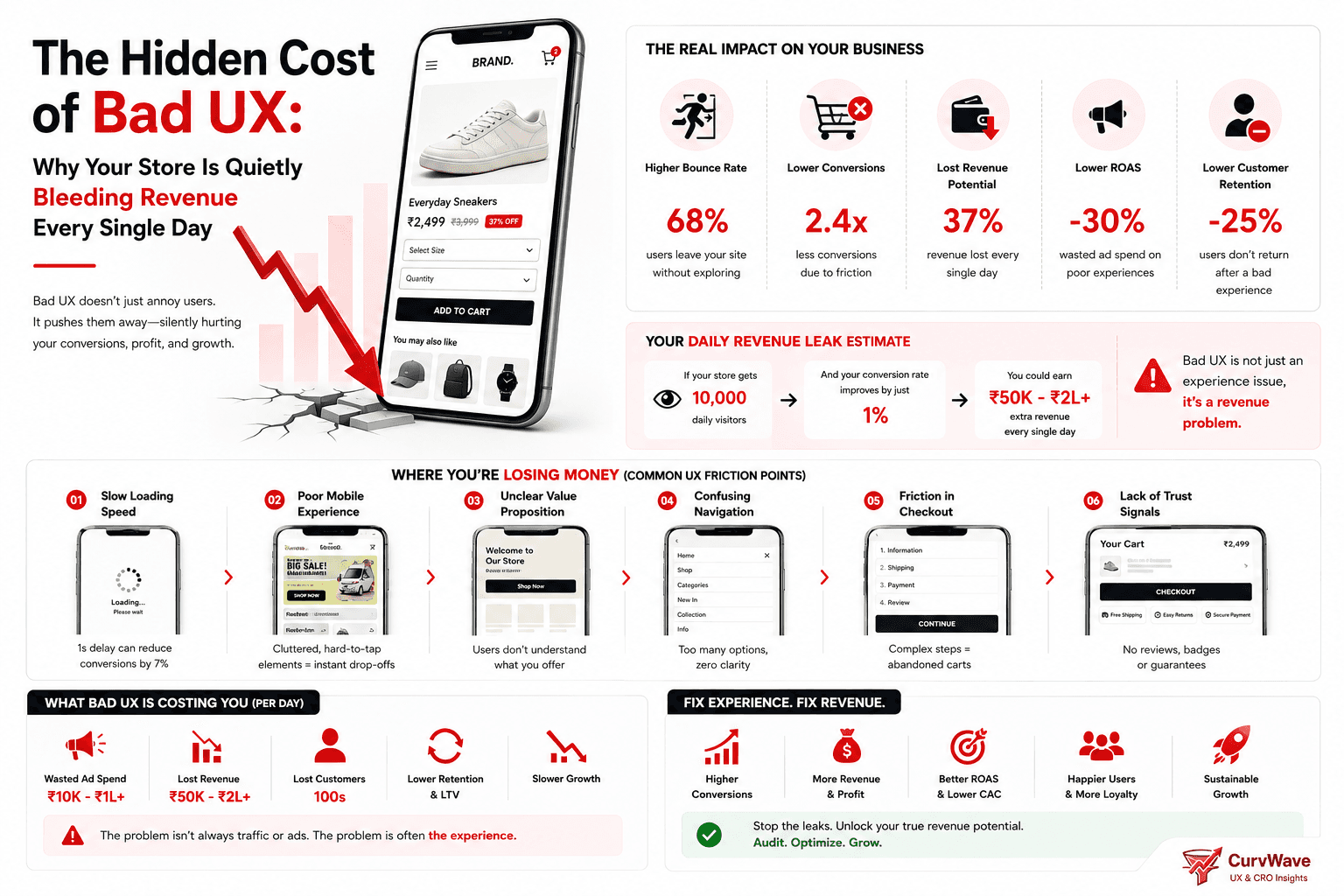
When a D2C brand experiences a sudden plateau in growth, the immediate reaction is almost always panic over marketing. Founders pump more capital into Meta and Google, tweaking target audiences and testing fresh video creatives. Yet, the core conversion metrics flatline.
During our diagnostic evaluations, we consistently find that the real issue isn't coming from your traffic source—it's happening right inside your website architecture. When digital interfaces ignore fundamental human psychology, visitors quietly abandon their carts without a trace.
1. The Illusion of "Traffic Solves Everything"
Pouring high-intent traffic into an unoptimized store is like pouring water into a bucket full of microscopic holes. No matter how much resource you spend filling it, the volume inside never grows.
The Fix: Shift focus from acquisition to retention architecture. Prioritize a comprehensive UX audit to plug conversion leaks before scaling your media budget.
2. Micro-Friction Points That Exhaust the Buyer
Shoppers online are inherently impatient. If your form fields are bloated, touch targets are too cramped on mobile screens, or navigation menus require too many cognitive steps, user frustration spikes instantly.
The Fix: Streamline pathways. Reduce checkout form fields, ensure single-tap responsiveness, and make interactive elements thumb-friendly to keep cognitive load as low as possible.
3. Aligning Design With Human Expectation
When users click a back button or an anchor link expecting a specific behavior, any disruption to that mental model breaks trust. Digital experiences must flow intuitively with how human brains process visual information.
The Fix: Test your site mechanics rigorously against real user habits. Remove unexpected layout shifts, broken redirects, and cluttered visual elements that distract from the primary purchase goal.
Conclusion
Data tells you precisely where revenue is dropping off, but human-centric design brings those buyers back. Stop burning capital on leaky funnels and fix the underlying UX bottlenecks to unlock sustainable growth.
Join the CurvWave UX & CRO Insights newsletter
Marketing strategy is moving away from gut feelings toward data-backed engineering. What matters now is how well you can optimize for human behavior in a crowded market.
The growth operators pulling ahead are the ones building systems to identify friction, map user psychology, and automate conversion flows. At the same time, maintaining a high-converting funnel has become a massive challenge because testing variables takes time—and most brands lack the bandwidth to do it effectively.
That’s why I built CurvWave UX & CRO Insights: to help D2C founders and growth teams move from "guessing" to "engineering" their success. Every week, I share 3-4 deep-dives covering UX audits, funnel psychology, and AI-driven workflow experiments that you can implement immediately.
You can join the newsletter here
Kirtika Srivastava
Kirtika is the founder of CurvWave and the voice behind the CurvWave UX & CRO Insights newsletter. She specializes in the intersection of human psychology and AI-driven conversion engineering. With a deep focus on UX audits and CRO, she helps high-growth D2C brands identify invisible friction and transform it into measurable revenue. She is also the author of ‘UX Decoded’ and ‘Design Mastery’.