Why Your Product Page is Repelling High-Intent Buyers
Home Blog D2C
By: Kirtika Srivastava Published: Aug 01, 2026
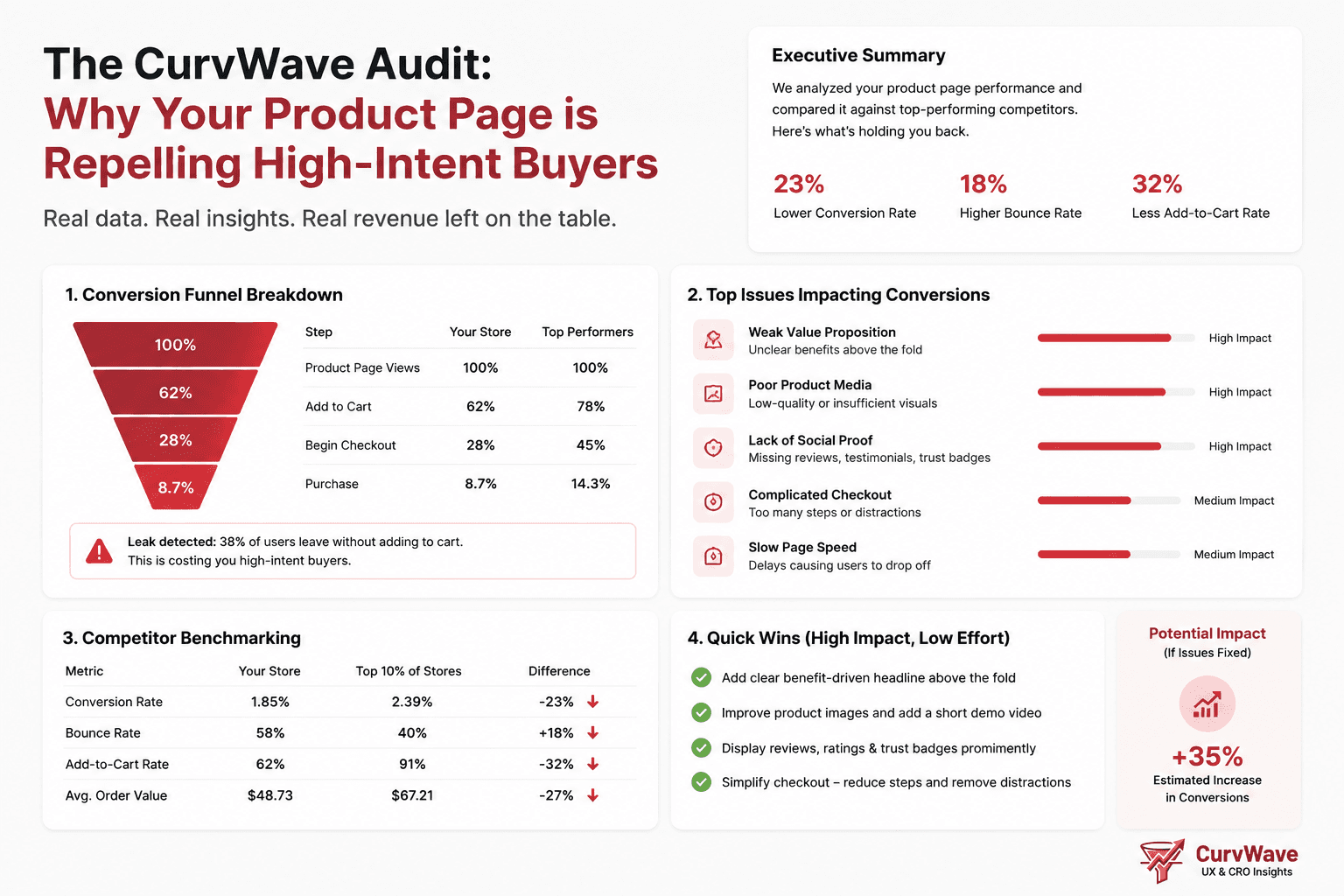
When D2C founders complain that "Meta and Google Ads are getting too expensive," we usually find a completely different culprit during a CurvWave UX Audit. The ads aren't failing—your product page is. You are spending thousands driving high-intent shoppers to a page that creates more confusion than confidence.
1. The "Feature-Dump" Trap
Too many brands list technical specifications like a machine manual. Human brains don’t buy specs; they buy "better versions of themselves." If a customer has to read a technical wall of text to understand what your product does, they will bounce.
The CurvWave Fix: Translate every feature into an immediate human benefit. Instead of "Made with 300 GSM combed cotton," show "Stays crisp and breathable all night so you never wake up sweaty."
2. The Hierarchy Disconnect
When a user lands on a product page, their eyes scan in an F-pattern. If your "Add to Cart" button is hidden below the fold, or if the price is buried under complex dropdowns, you are forcing the user to work too hard.
The CurvWave Fix: Put the core value proposition, high-res visual proof, social validation, and the CTA within the primary viewport. Reduce cognitive load so the purchase path is completely frictionless.
3. Addressing Objections Before They Happen
Every shopper has silent doubts: Will this fit me? Is delivery free? What if I hate it? If your product page doesn't answer these questions instantly, hesitation turns into abandonment.
The CurvWave Fix: Place clear trust signals, sizing charts, and hassle-free return policies right next to the buy button. Remove every element of doubt.
Conclusion
At CurvWave, our core philosophy remains simple: Data tells you where users leave, but human psychology brings them back. Stop blaming your ad spend and start fixing the silent UX leaks on your product pages.
Join the CurvWave UX & CRO Insights newsletter
Marketing strategy is moving away from gut feelings toward data-backed engineering. What matters now is how well you can optimize for human behavior in a crowded market.
The growth operators pulling ahead are the ones building systems to identify friction, map user psychology, and automate conversion flows. At the same time, maintaining a high-converting funnel has become a massive challenge because testing variables takes time—and most brands lack the bandwidth to do it effectively.
That’s why I built CurvWave UX & CRO Insights: to help D2C founders and growth teams move from "guessing" to "engineering" their success. Every week, I share 3-4 deep-dives covering UX audits, funnel psychology, and AI-driven workflow experiments that you can implement immediately.
You can join the newsletter here
Kirtika Srivastava
Kirtika is the founder of CurvWave and the voice behind the CurvWave UX & CRO Insights newsletter. She specializes in the intersection of human psychology and AI-driven conversion engineering. With a deep focus on UX audits and CRO, she helps high-growth D2C brands identify invisible friction and transform it into measurable revenue. She is also the author of ‘UX Decoded’ and ‘Design Mastery’.