The Post-Purchase Gap: Why You Are Losing Lifetime Value
Home Blog D2C
By: Kirtika Srivastava Published: Jul 12, 2026
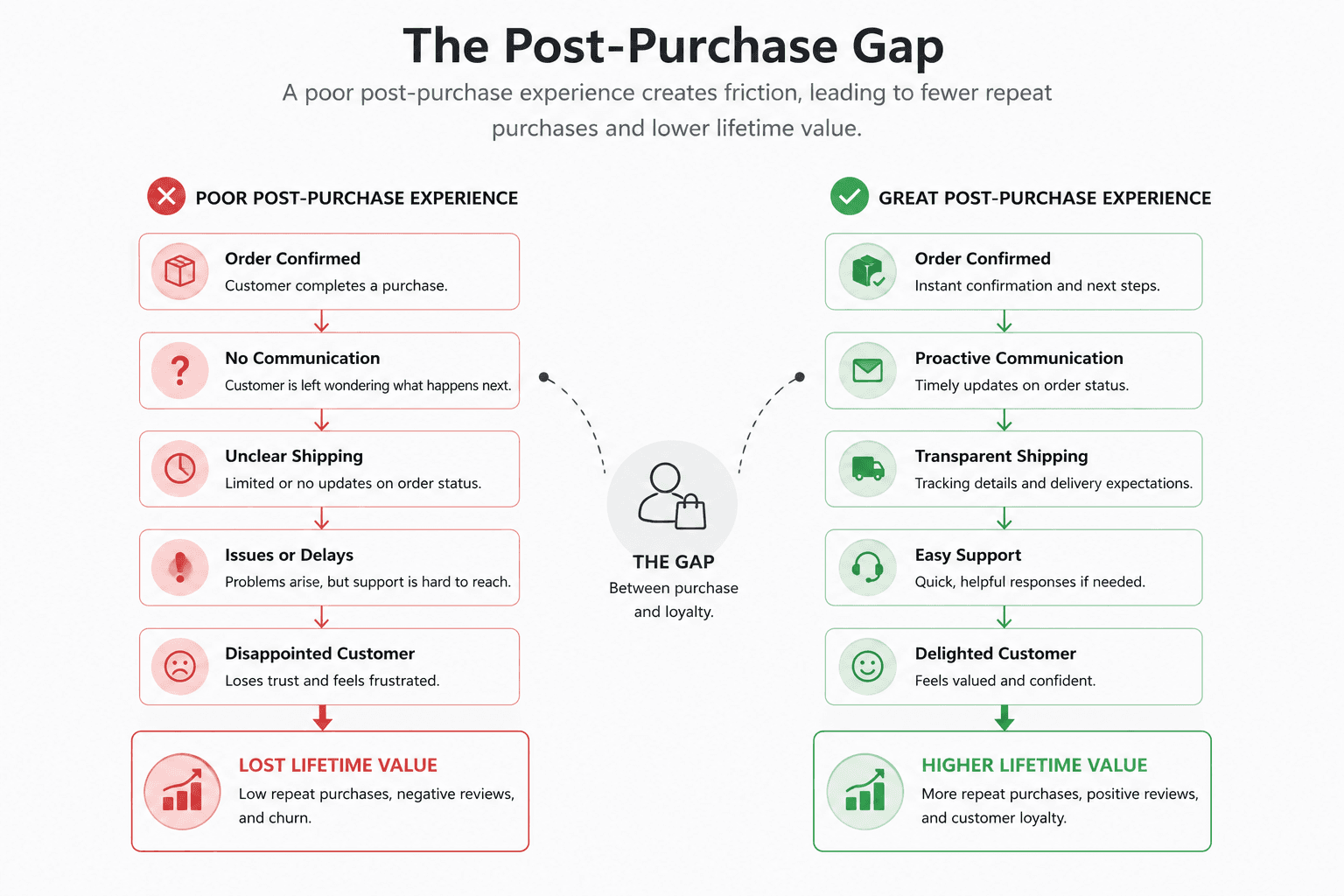
Acquiring a new customer is expensive, but keeping them is where the actual profit lies. Many D2C brands pour their entire budget into top-of-funnel acquisition, only to lose momentum the second a customer hits the "Thank You" page. This is the "Post-Purchase Gap"—a silent killer of Lifetime Value (LTV) and brand loyalty.
The mistake most brands make is treating the post-purchase experience as a transactional receipt rather than a brand-building opportunity. If your communication stops at "Your order is confirmed," you’ve lost the chance to turn a one-time buyer into a repeat customer.
1. Why the Gap Happens
The post-purchase gap occurs when the brand-customer relationship goes "dark." After the high of clicking "Buy," the customer enters a waiting period. If your only contact is a generic automated receipt, you lose the emotional connection. The customer feels like just another number, not a member of your brand's community.
2. The Hidden Cost of Neglect
When brands ignore the post-purchase journey, they face three major issues:
Churn: Customers don't come back because they never felt the brand's value beyond the product.
Increased Support Load: Lack of proactive communication leads to more "Where is my order?" (WISMO) tickets, draining your support team's time.
Lower LTV: Without a retention strategy, you have to pay for the same customer all over again.
Key Takeaways
Optimize the Unboxing Experience: Is your package just delivering goods, or is it telling a story that makes the customer feel good about their purchase?
Personalize Post-Purchase Flows: Use email and SMS to guide customers on product usage, maintenance, and tips, rather than just sending boring shipping updates.
Invite to Community: Use the excitement of the "Order Confirmed" moment to invite customers to your inner circle or exclusive community.
Surprise and Delight: Small, unexpected touches in the follow-up process create a lasting impression that drives brand advocacy.
Conclusion
The sale doesn't end at the checkout—that is where the real work begins. By closing the post-purchase gap, you transform one-time transactions into long-term customer relationships. Treat the post-purchase journey with the same intensity as your acquisition strategy, and you will see your LTV climb.
Join the CurvWave UX & CRO Insights newsletter
Marketing strategy is moving away from gut feelings toward data-backed engineering. What matters now is how well you can optimize for human behavior in a crowded market.
The growth operators pulling ahead are the ones building systems to identify friction, map user psychology, and automate conversion flows. At the same time, maintaining a high-converting funnel has become a massive challenge because testing variables takes time—and most brands lack the bandwidth to do it effectively.
That’s why I built CurvWave UX & CRO Insights: to help D2C founders and growth teams move from "guessing" to "engineering" their success. Every week, I share 3-4 deep-dives covering UX audits, funnel psychology, and AI-driven workflow experiments that you can implement immediately.
You can join the newsletter here
Kirtika Srivastava
Kirtika is the founder of CurvWave and the voice behind the CurvWave UX & CRO Insights newsletter. She specializes in the intersection of human psychology and AI-driven conversion engineering. With a deep focus on UX audits and CRO, she helps high-growth D2C brands identify invisible friction and transform it into measurable revenue. She is also the author of ‘UX Decoded’ and ‘Design Mastery’.