The Traffic Trap: Why Great Marketing Can’t Save a Bad Website
Home Blog D2C
By: Kirtika Srivastava Published: Jul 14, 2026
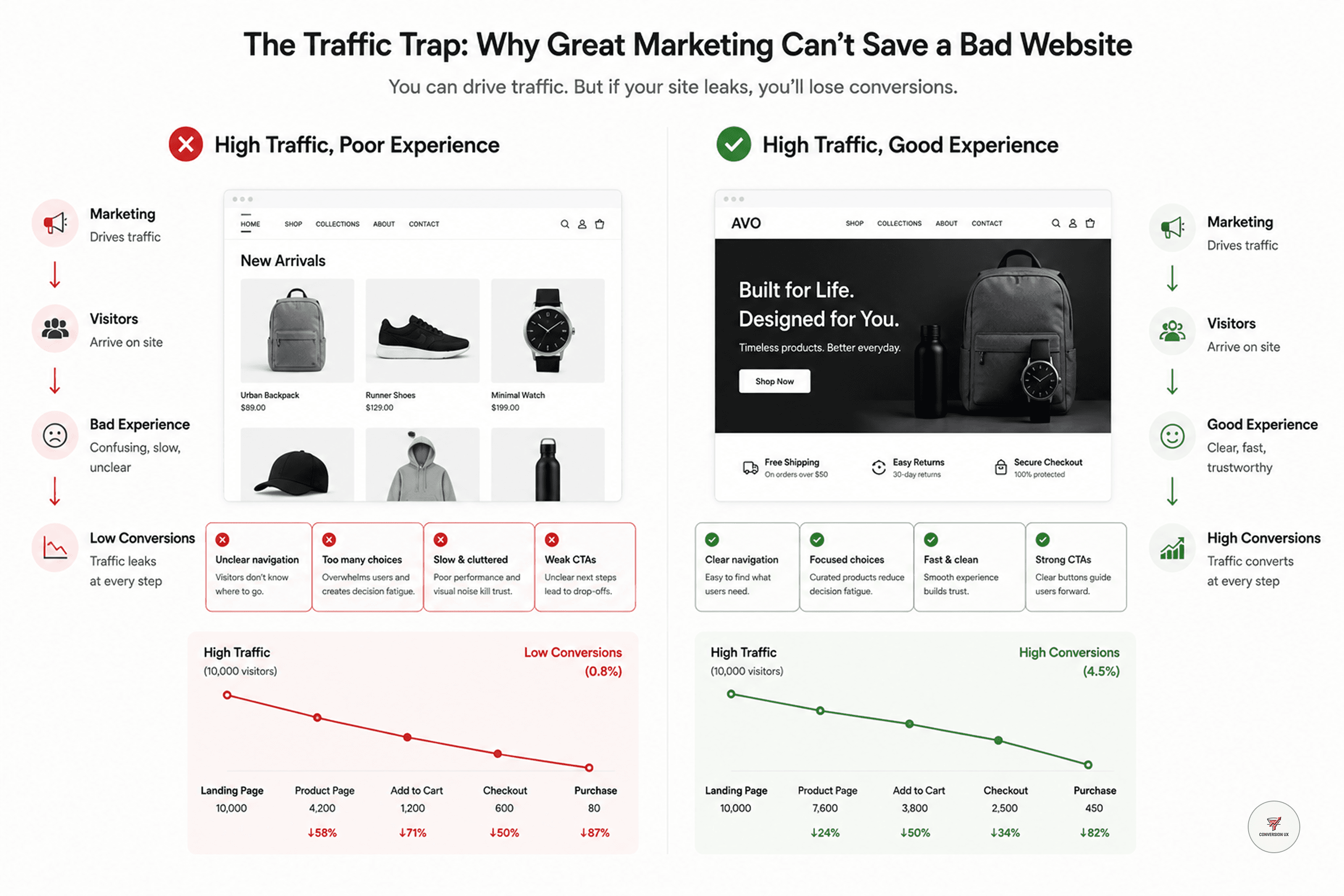
Many D2C founders are obsessed with the "Top of the Funnel." They pour their entire budget into Meta Ads, Influencers, and SEO content, hoping to flood their website with visitors. But here’s the harsh reality: Traffic is not revenue. If you are driving thousands of people to a website that is slow, confusing, or feels broken, you are literally setting your marketing budget on fire.
1. The SEO-UX Connection: Why Google Cares About Your "Feel"
Gone are the days when keywords were enough to rank #1. Today, Google tracks how your users interact with your site. If a user clicks your link, waits 5 seconds for it to load, and then bounces because the design is cluttered (poor UX), Google marks your site as "low quality." A high-performing website is now a prerequisite for ranking. If your site doesn't pass the Core Web Vitals—meaning it isn't fast, stable, and mobile-responsive—your marketing efforts are fighting an uphill battle against the algorithm itself.
2. Why Marketing is Just Half the Battle
Marketing opens the door, but UX keeps the customer inside the house. You can have the most persuasive copy and the best influencers, but if your product page has "Ghost Friction" or if your checkout flow is a nightmare, your conversion rate will never scale. Founders often blame the "marketing channel" when the conversion rate is low, when in reality, the culprit is a poor user experience that kills the momentum of the ad.
3. The CurvWave Growth Framework
To truly succeed, you need to align three pillars:
Acquisition (Marketing): Bringing the right audience to your site.
Performance (Speed): Ensuring the site loads instantly (Google’s ranking requirement).
Conversion (UX): Making the path to purchase so seamless that it feels automatic for the user.
Conclusion
Stop trying to fix your marketing until you have fixed your website. When you invest in performance and UX, you aren't just making your site look better; you are giving Google a reason to rank you higher and giving your customers a reason to stay. This is how you build a scalable D2C machine—not by outspending competitors on ads, but by outperforming them on the user experience.
Join the CurvWave UX & CRO Insights newsletter
Marketing strategy is moving away from gut feelings toward data-backed engineering. What matters now is how well you can optimize for human behavior in a crowded market.
The growth operators pulling ahead are the ones building systems to identify friction, map user psychology, and automate conversion flows. At the same time, maintaining a high-converting funnel has become a massive challenge because testing variables takes time—and most brands lack the bandwidth to do it effectively.
That’s why I built CurvWave UX & CRO Insights: to help D2C founders and growth teams move from "guessing" to "engineering" their success. Every week, I share 3-4 deep-dives covering UX audits, funnel psychology, and AI-driven workflow experiments that you can implement immediately.
You can join the newsletter here
Kirtika Srivastava
Kirtika is the founder of CurvWave and the voice behind the CurvWave UX & CRO Insights newsletter. She specializes in the intersection of human psychology and AI-driven conversion engineering. With a deep focus on UX audits and CRO, she helps high-growth D2C brands identify invisible friction and transform it into measurable revenue. She is also the author of ‘UX Decoded’ and ‘Design Mastery’.