The "Social Proof" Fallacy: Why Your Reviews Are Not Converting Shoppers
Home Blog D2C
By: Kirtika Srivastava Published: Jul 13, 2026
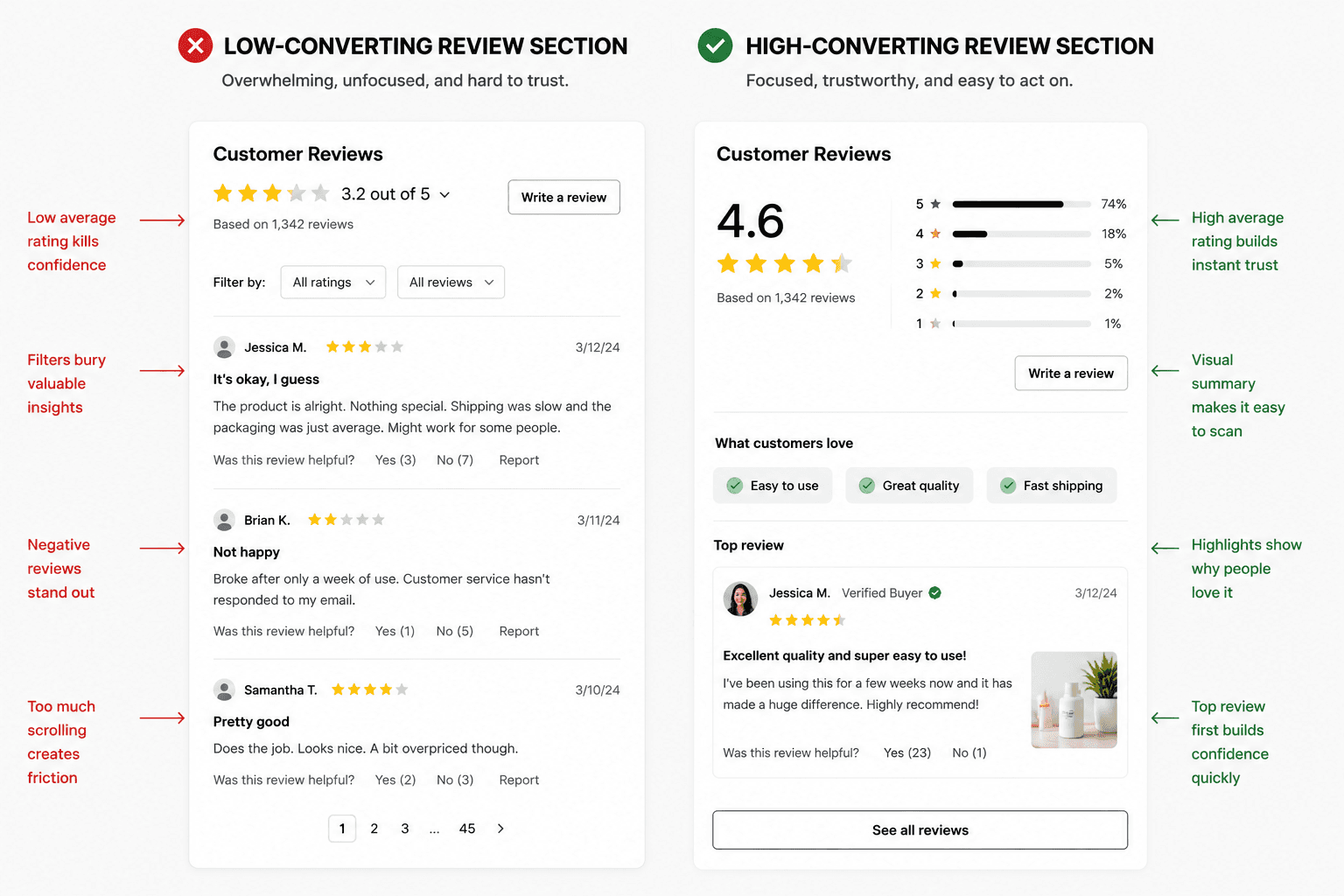
Most D2C founders believe that simply displaying a star rating widget is enough to build trust. If you have 500 reviews with a 4.8 rating, you assume the sale is guaranteed. However, if your conversion rates are still low, you are falling for the "Social Proof Fallacy." The problem isn't the number of reviews—it’s how you are presenting them to the customer.
1. The Noise vs. Signal Problem
When a potential buyer lands on your product page, they are looking for a reason not to buy. If your reviews are just generic "Great product!" or "Fast shipping!" comments, they add no value. This is "noise." A high-converting funnel requires "signal"—reviews that address the specific doubts, anxieties, or use-cases that your customer is currently thinking about.
2. Mapping Reviews to the User Journey
Stop treating reviews as an afterthought at the bottom of the page. Strategic social proof should be mapped to the customer’s psychological journey.
The "Anxiety" Phase: If your product is premium, place reviews that highlight value and longevity right below the price tag.
The "Use-Case" Phase: If your product solves a specific problem, feature a review that details the "before and after" experience.
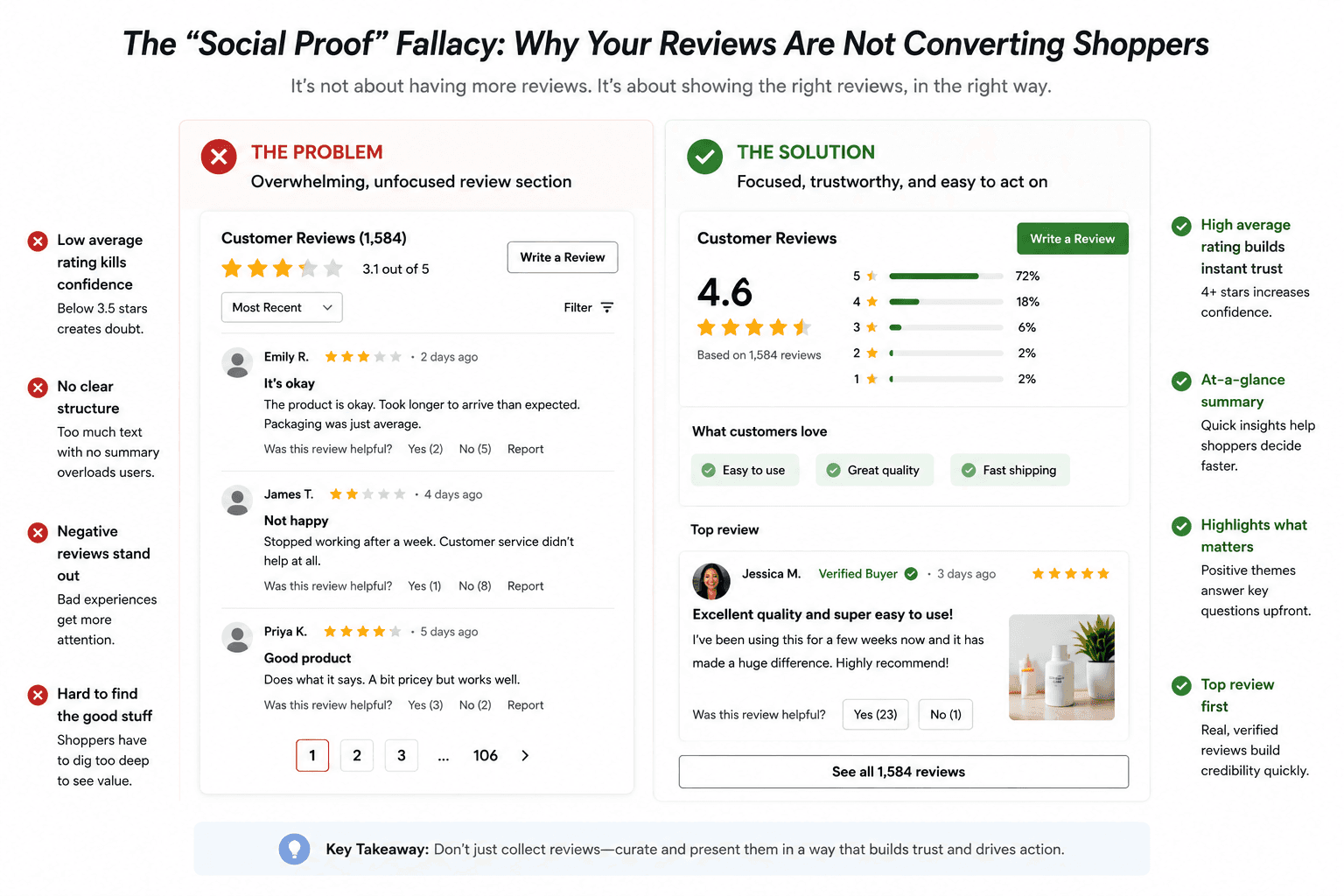
3. The Framework for High-Converting Proof
Contextual Reviews: Don't just show stars; show who is using the product. Include tags like "Verified Buyer," their skin type, or their primary use-case.
Address Objections Directly: Your most valuable reviews are the ones that address common objections (like size, durability, or ease of use). Highlight these specific reviews near your "Add to Cart" button.
Video Social Proof: In a crowded market, a 15-second unboxing or testimonial video on your product page is worth more than 100 text-based reviews.
Conclusion
Social proof isn't about bragging; it’s about reducing the perceived risk of a purchase. When you align your reviews with your customer's specific questions and hesitations, you stop "showing" stars and start "building" deep, data-backed trust.
Join the CurvWave UX & CRO Insights newsletter
Marketing strategy is moving away from gut feelings toward data-backed engineering. What matters now is how well you can optimize for human behavior in a crowded market.
The growth operators pulling ahead are the ones building systems to identify friction, map user psychology, and automate conversion flows. At the same time, maintaining a high-converting funnel has become a massive challenge because testing variables takes time—and most brands lack the bandwidth to do it effectively.
That’s why I built CurvWave UX & CRO Insights: to help D2C founders and growth teams move from "guessing" to "engineering" their success. Every week, I share 3-4 deep-dives covering UX audits, funnel psychology, and AI-driven workflow experiments that you can implement immediately.
You can join the newsletter here
Kirtika Srivastava
Kirtika is the founder of CurvWave and the voice behind the CurvWave UX & CRO Insights newsletter. She specializes in the intersection of human psychology and AI-driven conversion engineering. With a deep focus on UX audits and CRO, she helps high-growth D2C brands identify invisible friction and transform it into measurable revenue. She is also the author of ‘UX Decoded’ and ‘Design Mastery’.